
If your brand or agency already runs online ads, you’re probably familiar with programmatic buying. You may have even used a demand-side platform (DSP). While programmatic DOOH uses similar automation technology, it works very differently from other digital formats – especially because DOOH takes place in public environments, not personal screens.
So let’s break it down in simple, human-friendly words.
Programmatic Digital Out-of-Home (pDOOH) is the automated buying, selling, and delivery of digital outdoor ads – such as digital billboards, screens, kiosks, and signage. Just like online programmatic ads, software decides when and where an ad should play based on conditions you set.
Sounds easy? It is, but with some key differences.
In pDOOH, ads appear on public screens, not on someone’s phone or laptop. This means your tactics, your creative, and your targeting strategy need a different approach.
Let’s explore what DOOH and pDOOH are, why they’re powerful, and how they work together.
What Is DOOH Advertising?
Here’s a quick refresher on why DOOH is one of the fastest-growing ad formats globally.
Marketers are steadily shifting budgets into DOOH. In 2023, one-third of all OOH spending went to DOOH, and experts expect another 10% growth by the end of 2024.
So, why the surge? DOOH has some amazing strengths.
1. DOOH delivers massive visual impact
Digital screens offer a huge creative canvas that mobile and desktop simply cannot match.
From giant LED billboards to digital bus stops and in-mall signage, DOOH stands out, and people notice it.
2. DOOH can’t be skipped or blocked
There are no ad-blockers. No “skip ad” buttons. No switching tabs.
That’s why 88% of U.S. adults notice OOH ads, and nearly 80% have interacted with one in the last two months.
3. DOOH boosts your other marketing channels
According to MRI-Simmons and the OAAA, combining OOH with other channels can increase campaign reach by up to 100%. DOOH acts as an amplifier.
4. DOOH drives real-world action
A recent Harris Poll found that 76% of DOOH viewers take action after seeing an ad – visiting a store, scanning a QR code, searching online, or talking about it.
Now imagine taking all this power and adding automation, data, and real-time optimization on top.
That’s where programmatic DOOH comes in.
pDOOH vs DOOH: Why Programmatic Is Even Better
Think of pDOOH as DOOH on steroids, smarter, faster, more flexible, and data-driven.
1. pDOOH is powered by real-time data
This is the heart of programmatic DOOH.
You can set rules based on conditions like:
- Time of day
- Weather
- Traffic
- Location
- Live sports scores
- Stock market data
- Audience movement
- Event schedules
When the condition is met, your ad automatically plays.
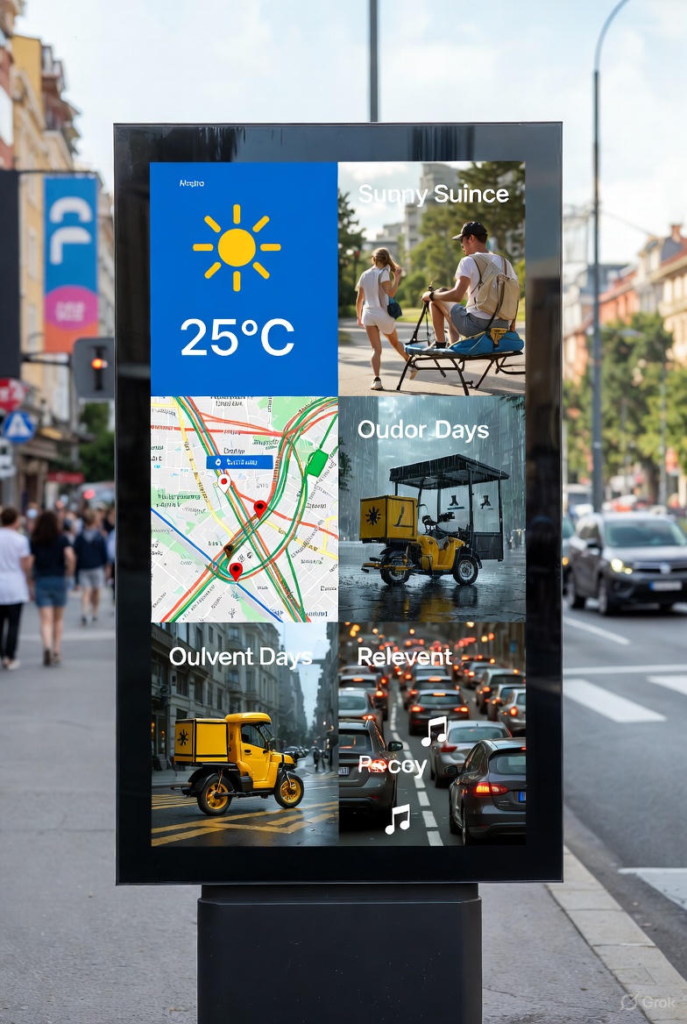
This unlocks endless creative possibilities. For example:
- Sunny → “Take a walk and pick up your order.”
- Raining → “Stay in! Order delivery.”
- Lunchtime → nearest restaurants
- Traffic jam → music, entertainment, or coffee brands
You can combine multiple triggers to get ultra-precise targeting.
2. pDOOH is more flexible and faster to activate
Traditional DOOH often requires booking weeks in advance. With programmatic:
- You can buy inventory in near real time
- Adjust budgets instantly
- Pause or scale your campaign immediately
- Swap creatives at any time
- Optimize based on performance
This flexibility is a key reason why 52% of advertisers now consider pDOOH a regular part of their strategy, according to IAB Australia.
And here’s the magic:
Once you set up the campaign, the system handles everything. No repeated manual bookings.
3. pDOOH is easily accessible through major DSPs
More DSPs now support DOOH, which means:
- You can add DOOH to your omnichannel campaigns
- Reuse existing digital assets
- Buy screens across multiple publishers at once
- Manage everything from your usual DSP dashboard
Dynamic creatives and HTML5 formats make it even easier to adapt online content for DOOH screens.
As adoption grows, programmatic DOOH is becoming a standard part of modern media buying.
Measuring the ROI of pDOOH
One challenge with DOOH is that it’s a one-to-many medium.
A single ad can generate hundreds of impressions; but it doesn’t work like online “one ad = one impression.”
Luckily, advances in tech and data have made DOOH measurement far more powerful.
Here are the key metrics brands use:
1. Brand Lift
Surveys near exposure zones measure:
- Ad recall
- Awareness
- Consideration
- Purchase intent
2. Foot Traffic Attribution
Ideal for retail and QSR brands.
This tracks whether people visited a location after seeing a DOOH ad.
3. Mobile Retargeting
Using privacy-safe device IDs, exposed audiences can be re-engaged with mobile ads, and their behavior measured.
4. QR Code Attribution
Perfect for interactive DOOH. Scans can track engagement, conversions, and A/B test performance.
These metrics help advertisers prove the real-world impact of pDOOH campaigns.
Final Thoughts
Programmatic DOOH is still young, but it’s transforming outdoor advertising at lightning speed. It combines the scale and creativity of DOOH with the precision and flexibility of digital media.
If you’re already running online ads, adding pDOOH to your strategy is easier; and more impactful, than you might think. Try it, test it, and watch how it enhances your omnichannel campaigns.
You may be surprised by just how powerful it is.
Also, read: What Is Programmatic OOH? Advantages & Benefits Explained
Affordable DOOH Advertising Packages for Retail & Restaurant Chains in Singapore
External references:
Broadsign: https://broadsign.com/blog/what-is-programmatic-digital-out-of-home/
Moving Walls: https://www.movingwalls.com/blog/programmatic-dooh-explained/
Perion: https://perion.com/dooh/the-fundamentals-of-ooh-dooh-vs-programmatic-dooh