
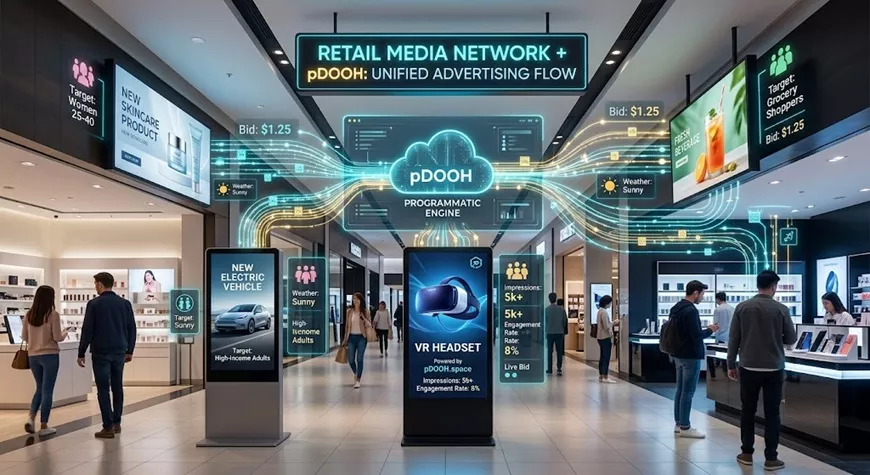
Walk into almost any retail boardroom in 2026 and you’ll hear the same phrase: retail media network. What used to mean sponsored product listings on an e-commerce homepage has exploded into a category worth tens of billions of dollars, and it’s now spilling out of the browser and onto physical screens.
That’s where programmatic DOOH comes in.
Retailers who spent the last few years building “walled garden” ad businesses online are now looking at their in-store screens, mall displays, and forecourt signage and asking an obvious question: why should the media network stop at the checkout page? The answer is that it doesn’t have to, and pDOOH is the technology making the jump possible.
Why Retail Media Is Suddenly Everywhere
Retail media has grown faster than almost any other ad category over the past three years. In the US alone, digital retail media ad spend is projected to hit roughly $69 billion in 2026, up nearly 18% year-over-year, and analysts expect that growth to keep compounding as brands chase first-party shopper data and closed-loop attribution (eMarketer).
The pitch to advertisers is simple: retailers know who is buying what, when, and how often. That data is far more valuable than a cookie-based guess, and it’s the reason CPG brands, in particular, have piled billions into retail media budgets. But nearly all of that spend has gone to on-site placements; banner ads on retailer apps and websites. In-store media, where 80% of purchases still actually happen, has been left behind, largely because retailers didn’t have a scalable way to sell it.
Programmatic DOOH fixes that gap.
From Static Signage to Programmatic Inventory
A decade ago, the screen above a supermarket checkout or the digital panel in a mall atrium was, at best, a manually booked ad slot sold by a local sales rep. Today, retailers are digitizing those same screens and connecting them to demand-side platforms the same way programmatic DOOH buying already works for transit and roadside inventory.
The mechanics are familiar if you’ve followed pDOOH: a supply-side platform packages up the retailer’s screen inventory, brands bid on it through their DSP of choice, and the highest relevant bid wins the slot in real time. What’s new is the data layer sitting behind it. Instead of bidding on generic foot traffic estimates, brands can now target based on verified store transaction data, category-level purchase intent, and even loyalty program signals, turning a mall screen or in-store display into an extension of the retailer’s own first-party data stack.
Moving Walls has documented this shift closely, noting that shopping malls and retail chains are increasingly treating their screen networks as media businesses in their own right rather than just navigational signage, connecting inventory to a global programmatic marketplace via an SSP to attract premium advertisers who were previously out of reach (Moving Walls: 3 Steps to Boost In-Mall Revenue with Programmatic DOOH).
What Makes In-Store pDOOH Different
Retail media DOOH isn’t just roadside advertising moved indoors. A few things set it apart:
- Point-of-purchase proximity. A shopper seeing an ad three feet from the shelf is a fundamentally different moment than a commuter glancing at a highway billboard. Dwell time is longer, intent is higher, and the ad can be tied almost directly to a transaction.
- First-party data targeting. Retailers can trigger creative based on verified category spend, weekend versus weekday buying patterns, or event-driven demand spikes, rather than relying on anonymized mobile location data alone.
- Closed-loop measurement. Because the retailer already has the sales data, connecting an ad exposure to an actual purchase is far more direct than the mobile retargeting or geofencing models used in typical pDOOH attribution.
This is also why the format is landing well with brands beyond CPG. Retailers with strong footfall, think malls, pharmacies, convenience chains, and even the restaurant and QSR screens already popular in dense retail markets like Singapore, are finding that programmatic in-store screens can now compete for the same ad dollars as online retail media placements, just with better recall and a real-world setting that’s impossible to scroll past.
The Numbers Behind the Shift
The scale here is hard to ignore. Global retail media spend is on track to grow from roughly $184 billion in 2025 to over $300 billion by 2030, and in-store retail media specifically, still a small slice of that today, is one of the fastest-growing sub-segments as retailers digitize physical screens and connect them to programmatic demand. For media owners sitting on underused screen networks, that represents a genuine new revenue line rather than a marginal upgrade.
For brands, it also means a new line item to plan for. Retail media budgets that were once purely digital are starting to carve out allocations for in-store and mall-based DOOH, particularly for categories like beauty, grocery, and electronics where the path from screen to shelf is short.
What Media Owners Should Do Next
If you operate physical screens; in a mall, a retail chain, a pharmacy network, or a transit hub with retail tenants, the convergence of retail media and pDOOH is worth acting on rather than watching from the sidelines. A few practical starting points:
- Audit your existing screen footprint. Entrance displays, checkout screens, and directory kiosks are all monetizable inventory once they’re connected to a programmatic supply chain.
- Prioritize data partnerships. The advertisers paying premium CPMs for retail media want the same first-party targeting they get online. Screens without a data layer behind them will get commoditized fast.
- Get comfortable with proof, not promises. Brands moving budget from online retail media to in-store DOOH will expect the same closed-loop reporting they’re used to, so measurement can’t be an afterthought.
Final Thoughts
Retail media was always going to outgrow the browser. With programmatic DOOH providing the plumbing, the walled gardens retailers built online are extending into the physical spaces where most purchases still happen. For media owners, that’s a new revenue channel sitting in plain sight. For brands, it’s a chance to reach shoppers at the moment that matters most, right in front of the shelf.
The retailers who move early on connecting their physical screens to programmatic demand are likely to be the ones capturing outsized value as this category scales through the rest of the decade.