
Key Takeaways
✓ AI-powered PDOOH uses machine learning to predict audience behavior and optimize campaigns in real time
✓ Predictive modeling allows brands to achieve faster optimization with less manual intervention
✓ Real-time audience intelligence means inventory is priced and targeted based on actual predicted audience quality, not historical averages
✓ Automated creative optimization tests and scales high-performing variations across hundreds of screens simultaneously
✓ Media owners can increase yield and reduce operational overhead with AI-driven campaign management
What Is AI-Powered PDOOH?
Artificial intelligence has quietly transformed almost every corner of digital advertising, from email to social media to search. But outdoor advertising has been slower to adopt AI at scale. That’s rapidly changing.
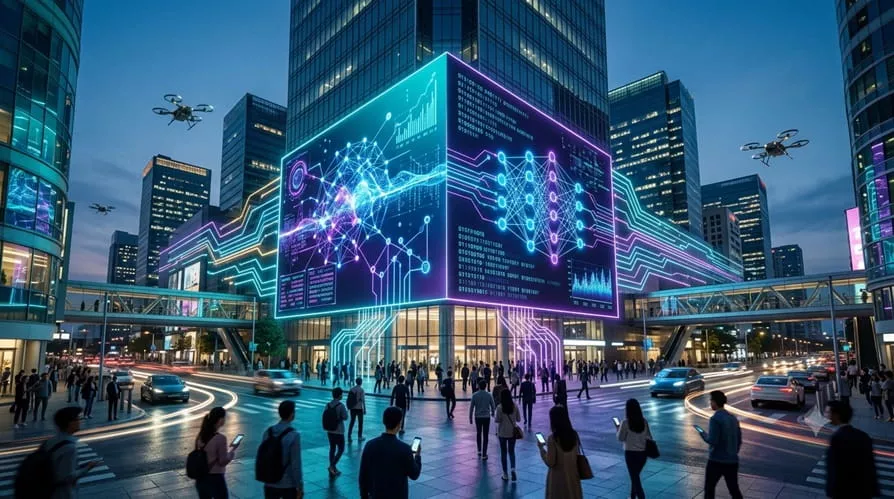
AI-powered PDOOH is the intersection of machine learning algorithms and programmatic out-of-home buying. It means software doesn’t just execute pre-set rules anymore; it learns, predicts, and optimizes campaigns in ways human planners never could; at speeds measured in milliseconds.
Think of it this way: traditional programmatic DOOH buying relies on conditional logic you define upfront. “If it’s raining at 2 PM on a Tuesday in this ZIP code, show this creative.” That works well.
But AI-powered PDOOH asks a different question: what if the system learned the optimal conditions for your specific creative, weather, time, location, crowd composition, even emotional context from computer vision; without you having to define them manually? That’s the promise of AI-driven optimization.
The Role of Machine Learning in Programmatic DOOH
Machine learning models in PDOOH systems operate on historical campaign data and real-time environmental inputs. Here’s what they’re doing today:
1. Predictive Performance Modeling
ML algorithms analyze hundreds of past campaigns, identifying which creative variations performed best under specific circumstances. The system doesn’t just know that a campaign worked; it understands why, the combination of factors that led to higher engagement.
When a new campaign launches, the algorithm starts with those predictions, then refines them based on live performance. Brands see faster time-to-optimization because the machine is learning from patterns across thousands of similar campaigns, not just from their own historical data.
2. Real-Time Audience Segmentation
Traditional PDOOH targeting might segment by general demographics or broad location categories. AI systems can segment far more granularly, not just “people at the mall,” but “people who have entered the mall, lingered in the food court, and have smartphone signals indicating they’re from affluent neighborhoods.”
This happens instantly, without invading privacy, because the segmentation is behavioral and aggregated, not individual-level tracking.
3. Contextual Intelligence Beyond Weather
While dynamic creative optimization based on weather and time is powerful, AI systems now incorporate much richer context:
- Event proximity. Is there a major sporting event, concert, or conference happening nearby? The system knows.
- Crowd sentiment. Computer vision can detect crowd density and emotional cues, informing whether to show an uplifting message or an energetic one.
- Cross-channel signals. Integration with retail media and mobility data lets the system know if exposed audiences are likely to visit a store within the hour.
Real-Time Audience Intelligence
One of AI’s biggest contributions to PDOOH is turning static audience estimates into dynamic intelligence.
Historically, screen inventory was bought on educated guesses about foot traffic; “this mall screen gets 50,000 impressions daily.” But that number hides a lot of variance. The audience at 9 AM is completely different from the audience at 9 PM. The audience on Saturdays differs from weekdays.
AI-powered systems observe and predict these variations minute by minute.
Using historical footfall data, event calendars, weather forecasts, and even social media sentiment, the system predicts not just how many people will see an ad, but who they are. A beauty brand targeting women 25-40 interested in skincare sees higher CPMs at certain times and locations because the algorithm has learned when those specific segments are most likely to be present.
For media owners, this translates into better yield. Inventory that used to be sold as “unsold slots” at discount rates can now be dynamically priced based on predicted audience quality. For brands, it means CPMs are justified by real audience intelligence, not guesswork.
Predictive Creative Optimization
This is where AI starts to feel like science fiction, but it’s already happening.
Machine learning can now predict which creative elements – color, text, imagery, messaging tone, will resonate best with the predicted audience at the predicted time in the predicted location. Some systems test creative variations micro-targeting, running dozens of A/B tests simultaneously across different screens and times, then pooling insights to optimize at scale.
For example, an e-commerce brand running a DOOH campaign might discover (via AI analysis) that:
- Customers in suburban areas respond 23% better to lifestyle imagery than product shots.
- The same brand’s ads get 18% more engagement when they include a QR code versus just a URL.
- Video performs 40% better than static creative during rush hours.
The algorithm surfaces these insights and starts automatically favoring the winning combinations, learning and adapting across hundreds of screens simultaneously.
This is dynamic creative optimization on steroids.
Automated Campaign Performance Management
Manual campaign management in PDOOH is increasingly inefficient. With thousands of screens and millions of possible combinations of time, location, audience, and creative, human optimization becomes a bottleneck.
AI systems can:
- Reallocate budget in real time. If a campaign is underperforming on certain screen networks, the system automatically shifts spend to better-performing inventory.
- Pause and restart campaigns intelligently. Rather than a human noticing a campaign is underperforming after a week, the algorithm catches it within hours and either optimizes or pauses.
- Surface anomalies. If a screen suddenly starts underperforming, the algorithm flags it – helping media owners identify technical issues or environmental changes.
For media owners using systems like those documented by Moving Walls’ programmatic DOOH integrations, automated management means screens generate consistent revenue with less manual intervention.
The Competitive Advantage for Brands and Media Owners
For Brands
Brands using AI-powered PDOOH see measurable improvements:
- Faster time-to-optimization (days instead of weeks)
- Higher engagement rates
- Better ROI attribution because performance is easier to measure at scale
- Lower waste on poorly-targeted inventory
AI also makes reaching Gen Z and Millennial audiences more efficient. These cohorts are data-native; they expect personalized, contextually relevant messaging. AI systems can deliver that personalization at scale on DOOH screens, something manual buying cannot achieve.
For Media Owners
AI unlocks new revenue:
- Higher CPMs for premium inventory (backed by audience intelligence)
- Automation reduces operational overhead
- Better yield management ensures inventory is always sold at fair market rates
- Scalability – one AI system can manage thousands of screens across multiple networks
Challenges and Future Outlook
AI in PDOOH is not without challenges. Privacy concerns, data governance, and the need for high-quality training data are all barriers to adoption. Not every system is equally sophisticated; some vendors claim AI capabilities but rely on simpler rule-based logic.
There’s also the fundamental challenge of attribution. Even with AI, proving the real-world impact of a DOOH campaign (store visit, conversion, brand lift) remains harder than online attribution. AI can help bridge this gap by correlating exposure with retail data, loyalty signals, and mobile retargeting, but it’s still not a solved problem.
That said, the trajectory is clear. AI in PDOOH will become standard by 2027, not cutting-edge. Early adopters, brands and media owners who invest now – will have a measurable advantage over competitors.
Final Thoughts
Artificial intelligence is not replacing human judgment in PDOOH; it’s amplifying it. It handles the volume, speed, and complexity that humans cannot, freeing strategic minds to focus on bigger questions: Which audiences matter most? What is the right message? How does DOOH fit into a broader omnichannel strategy?
The most successful PDOOH campaigns in 2026 won’t be the ones with the most advanced AI. They’ll be the ones where humans and machines collaborate, where algorithms handle optimization, and strategists handle vision.
If your brand is already thinking about PDOOH, now is the time to understand how AI is reshaping the landscape. And if you’re a media owner sitting on screen inventory, automated management can turn passive assets into active revenue drivers.
The future of programmatic DOOH is intelligent, automated, and efficient. The question is: will you be leading that shift or playing catch-up?
External Resources
For industry-specific insights on how major media companies are implementing AI in DOOH networks, see Moving Walls’ guide on programmatic DOOH in retail environments, which details how automation and AI are transforming in-store advertising.
Additionally, the IAB’s guidelines on DOOH measurement and performance standards provide crucial frameworks for understanding how AI-powered systems should report and validate campaign results.
Have questions about AI-powered PDOOH? Leave a comment below or reach out to discuss how your brand or media network can adopt these technologies.
About the Author
Dinesh is a programmatic DOOH specialist and content strategist at pDOOH Space. He writes about the intersection of technology, data, and out-of-home advertising.