
Choosing the right demand-side platform (DSP) for programmatic DOOH is one of the most critical decisions a brand or agency will make when entering the programmatic out-of-home space.
A DSP is the software hub where you buy inventory, set targeting parameters, manage budgets, and track performance. But not all DSPs are created equal, and not all are optimized for DOOH specifically.
The wrong choice can mean wasted budget, poor targeting, and missed optimization opportunities. The right choice unlocks the full potential of pDOOH’s real-time automation and data-driven targeting.
In this guide, we’ll break down the top programmatic DOOH platforms in 2026, what sets them apart, and how to choose the right one for your business.
What Is a DOOH DSP?
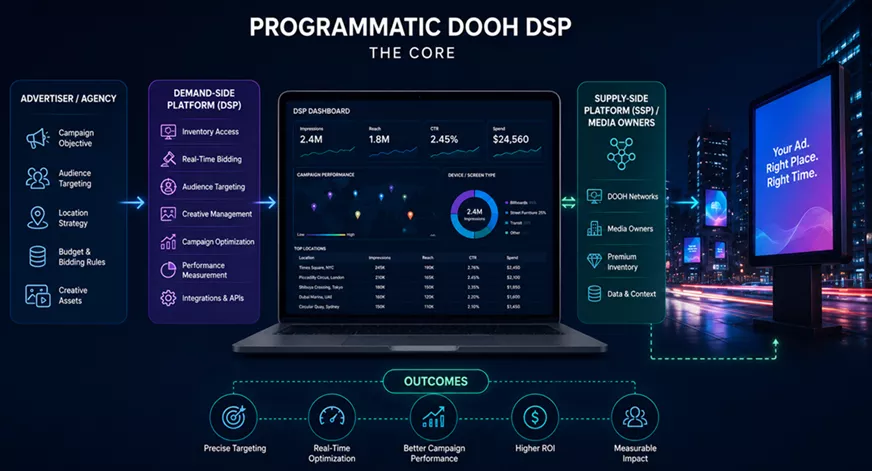
A demand-side platform (DSP) for DOOH is software that allows advertisers and agencies to buy digital out-of-home inventory programmatically. Unlike traditional DOOH buying, where a media buyer manually calls a network and books screens, a DSP automates this process through real-time bidding and algorithmic optimization.
Here’s what a DOOH DSP typically handles:
- Inventory Access: Connections to supply-side platforms (SSPs) and networks that represent thousands of screens globally
- Campaign Planning: Audience targeting, location selection, and campaign strategy
- Targeting: Geographic, demographic, contextual, and behavioral targeting options
- Real-Time Bidding: Automated bidding on available inventory in milliseconds
- Creative Management: Upload, store, and dynamically optimize multiple creative versions
- Performance Measurement: Track impressions, engagement, attribution, and ROI metrics
- Campaign Activation: Execute and optimize campaigns in real-time
- Integration: Connect to analytics platforms, CRMs, and other marketing tools
When you understand how programmatic DOOH buying works, you realize the DSP is the engine that makes it all possible.
Top Programmatic DOOH DSPs in 2026
1. Moving Walls
Best For: Brands, agencies, retailers seeking integrated ecosystem; full-stack solution from planning to measurement
Moving Walls has emerged as a comprehensive programmatic DOOH platform that uniquely spans both the demand and supply sides of the ecosystem. Unlike point solutions, Moving Walls provides an integrated platform for campaign planning, execution, measurement, and creative management.
Core Products for Buyers/Agencies:
- MW Planner – Plan DOOH campaigns using audience and location intelligence; set strategy before execution
- MW Activate – Execute and optimize campaigns in real-time with automated adjustments
- MW Influence – Audience-led targeting across screen networks with behavioral precision
- MW Measure – Real-world attribution and performance measurement
- MW Science – AI-powered audience and mobility intelligence for predictive optimization
- MW Market – Access premium DOOH inventory globally; connected ecosystem with media owners
- MW Studio – Creative management and dynamic content distribution across networks
Key Differentiators:
- Only platform spanning full ecosystem (buyer + seller + intelligence)
- Built-in AI for audience prediction and creative optimization
- Integrated measurement tied to real-world attribution
- Direct access to premium inventory through owned SSP relationships
- Creative management built into platform (not separate tool)
- End-to-end visibility: from planning through measurement
Ideal For: Enterprise brands, large agencies, retailers with national/global campaigns, organizations prioritizing measurement and attribution, teams that want unified platform instead of point solutions
Learning Curve: Moderate (comprehensive platform requires training, but integrated approach saves complexity)
Competitive Advantage: Moving Walls stands out because you’re not stitching together multiple tools. Planning, activation, measurement, and creative management are native to the platform. This integration often leads to better data flow and faster optimization cycles.
2. Broadsign Axis
Best For: Large-scale enterprise campaigns, omnichannel buyers, organizations seeking proven scale
Broadsign Axis is one of the oldest and most established DOOH platforms, having evolved from years of working with OOH networks globally. It’s designed for major brands and agencies running campaigns across multiple continents.
Key Features:
- Massive inventory access (50,000+ screens globally)
- Advanced audience segmentation and contextual targeting
- Native support for weather, traffic, and time-based triggering
- Strong integration with major DSPs for omnichannel buying
- Robust API for custom implementations
- Real-time dashboard for campaign monitoring
- Proven track record with enterprise clients
Ideal For: Large CPG brands, auto manufacturers, financial services firms looking for scale and reliability, organizations with complex multi-market campaigns
Learning Curve: Moderate to High (requires dedicated resources, but excellent support available)
3. Vistar Media
Best For: Mid-market and enterprise brands, those prioritizing ease of use without sacrificing power
Vistar Media is built specifically for programmatic DOOH and has become a favorite among brands that need both simplicity and power. Their platform emphasizes data, transparency, and ease of use.
Key Features:
- Clean, user-friendly interface
- Strong focus on audience quality metrics
- Integrations with Walmart, Target, and other retail networks
- Excellent real-time performance analytics
- Mobile-first creative recommendations
- Competitive pricing models
- Fast onboarding (weeks, not months)
Ideal For: Retail brands, CPG companies, quick-service restaurants seeking clean, easy-to-use interfaces, mid-market agencies
Learning Curve: Low to Moderate (purpose-built for self-service buying)
4. Quotient
Best For: Brands focused on point-of-purchase and retail environments, organizations with retail data access
Quotient has built a unique position in retail media by combining on-site retail media with in-store DOOH. If your campaign is tightly tied to retail, Quotient’s integrated approach is powerful.
Key Features:
- Unified platform for online retail media + in-store DOOH
- First-party retail data integration
- Closed-loop measurement tied to actual store sales
- Direct relationships with major retailers
- Simplified creative upload and management
- Excellent for quick-turnaround campaigns
Ideal For: Packaged goods brands, retailers launching store-level campaigns, brands that can leverage first-party retail data, CPG companies
Learning Curve: Low (specifically designed for retail marketers)
5. Cadent
Best For: Agencies, performance-driven campaigns, measurement-obsessed brands
Cadent brings a unique angle by focusing on data science and attribution. They’re excellent if you need to prove real-world impact—store visits, conversions, foot traffic attribution.
Key Features:
- Advanced machine learning for campaign optimization
- Location-based attribution (foot traffic tracking)
- Mobile retargeting integration
- Real-time bid optimization
- Strong onboarding and strategic support
- Built for performance marketers
Ideal For: Performance-focused agencies, brands that prioritize attribution and ROI proof, e-commerce companies, organizations requiring rigorous measurement
Learning Curve: Moderate (technical setup but strong support)
6. Standard Media
Best For: Emerging brands, smaller agencies, testing and learning, entry-level campaigns
Standard Media is one of the more accessible DOOH DSPs for brands new to programmatic. They offer lower minimum spend and flexible terms without sacrificing functionality.
Key Features:
- Lower minimum spend requirements ($10K-$25K campaigns)
- Simple onboarding process
- Good inventory coverage in major metros
- Transparent pricing
- Responsive customer support
- Good for testing creative and messaging
Ideal For: SMBs, emerging brands, agencies testing DOOH for clients, local and regional campaigns, organizations with limited budgets
Learning Curve: Low (designed for accessibility)
DSP Comparison Matrix: Features at a Glance
| Feature | Moving Walls | Broadsign | Vistar | Quotient | Cadent | Standard |
| Global Inventory | 40,000+ screens | 50,000+ screens | 40,000+ screens | 15,000+ screens | 30,000+ screens | 10,000+ screens |
| Minimum Spend | $25K+ | $50K+ | $25K+ | $25K+ | $30K+ | $10K+ |
| Ease of Use | High | Moderate | High | Very High | Moderate | High |
| Planning Tools | Excellent (MW Planner) | Good | Good | Good | Good | Basic |
| Real-Time Bidding | Yes | Yes | Yes | Yes | Yes | Yes |
| Weather/Time Triggers | Yes | Yes | Yes | Yes | Yes | Yes |
| AI/Predictive Intelligence | Excellent (MW Science) | Good | Good | Good | Excellent | Basic |
| Attribution/Foot Traffic | Excellent (MW Measure) | Limited | Good | Excellent | Excellent | Good |
| Creative Management | Integrated (MW Studio) | Separate tool | Integrated | Integrated | Separate tool | Basic |
| Retail Data Integration | Good | Limited | Yes | Excellent | Good | Limited |
| Unified Ecosystem | Yes (supply + demand) | Demand focused | Demand focused | Retail focused | Demand focused | Demand focused |
| API Access | Full | Full | Good | Good | Full | Limited |
| Best For | Integrated Ecosystem | Enterprise Scale | Mid-Market | Retail Focus | Attribution | Getting Started |
How to Choose the Right DOOH DSP
Before making a decision, ask yourself:
1. What’s your budget?
- Under $25K campaigns? → Standard Media
- $25K-$100K? → Moving Walls, Vistar Media, or Quotient
- $100K+? → Broadsign or Cadent
2. What’s your priority?
- Integrated platform (planning + activation + measurement)? → Moving Walls
- Scale and global reach? → Broadsign Axis
- Simplicity and user experience? → Vistar Media
- Retail/point-of-purchase? → Quotient
- Attribution and ROI proof? → Cadent
- Testing and learning? → Standard Media
3. Do you need built-in AI and predictive intelligence?
- Yes, integrated → Moving Walls (MW Science) or Cadent
- Yes, external → Broadsign or Vistar
- Not priority → Quotient or Standard
4. Do you have existing data partnerships?
- Retail POS data or loyalty program data? → Moving Walls (integrated retail) or Quotient (retail-native)
- Focus on mobile retargeting and foot traffic? → Cadent or Moving Walls (MW Measure)
- No existing data? → Broadsign or Vistar
5. What’s your campaign goal?
- Dynamic creative optimization across multiple variations? → Moving Walls (MW Studio), Broadsign, or Vistar
- Reaching specific demographics like Gen Z/Millennials? → Moving Walls (MW Influence), Vistar, or Cadent
- Proving real-world ROI with attribution? → Moving Walls (MW Measure), Quotient, or Cadent
- Omnichannel integration across online and offline? → Broadsign or Moving Walls
6. Do you need strategic support or prefer self-service?
- Managed service preferred? → Broadsign (enterprise) or Moving Walls (consultative)
- Self-service with good docs? → Vistar, Standard, or Moving Walls (flexible)
- Hands-on optimization support? → Cadent or Quotient
Moving Walls: The Ecosystem Play
Moving Walls deserves special attention because it represents a different approach: the integrated ecosystem platform.
Rather than being a pure DSP competing on features, Moving Walls has built an end-to-end platform that spans:
- Demand-side (planning, activation, influence)
- Supply-side (inventory access through MW Market)
- Intelligence (AI-powered audience modeling via MW Science)
- Measurement (real-world attribution via MW Measure)
- Creative (management and distribution via MW Studio)
This integrated approach offers distinct advantages:
- Better data flow – All components share the same data infrastructure
- Faster optimization – Planning insights feed directly into activation
- Unified measurement – Attribution is built in, not bolted on
- Reduced complexity – No stitching together multiple vendors
- Direct inventory relationships – Ownership of supply means better pricing and availability
If your organization values simplicity and wants to avoid point-solution fatigue, Moving Walls’ ecosystem approach can be compelling. If you prefer best-of-breed specialists in each category, the other platforms offer more flexibility.
Integration With Your Broader pDOOH Strategy
Whichever DSP you choose, it should integrate smoothly with your overall programmatic DOOH strategy. This means:
- Understanding how to measure DOOH success: Your DSP should support the KPIs that matter to you—brand lift, foot traffic, QR code scans, or actual conversions
- Leveraging real-time data: The best DSPs enable weather-based, time-based, and event-based creative triggers
- Connecting to AI optimization: Increasingly, platforms like Moving Walls show how machine learning is transforming DSP capabilities into predictive, proactive systems
The Evolution of DOOH DSPs in 2026
A few trends to watch as you evaluate DSP options:
Ecosystem Consolidation: Platforms like Moving Walls are proving that integrated solutions (spanning demand, supply, and intelligence) can compete with point solutions. Expect more platform companies to consolidate features.
AI-Powered Optimization: More platforms are embedding machine learning to predict performance and optimize budgets automatically.
Privacy-First Targeting: First-party data and contextual targeting are replacing cookie-based approaches—choose a platform that prioritizes this.
Unified Retail Strategies: The line between online retail media and in-store DOOH is blurring. DSPs that bridge both will have an advantage.
Real-Time Attribution: We’re moving beyond estimates toward actual sales-based attribution. Platforms connecting store transaction data with screen exposure are leading this shift.
Final Thoughts
The right DSP isn’t just a tool; it’s a partner in your programmatic DOOH journey. The best choice depends on your budget, goals, organizational structure, and existing data infrastructure.
If you’re seeking an integrated, end-to-end solution with built-in measurement and AI, Moving Walls offers ecosystem depth. If you’re an enterprise chasing global scale, Broadsign Axis remains the industry standard. If you’re a mid-market brand seeking simplicity, Vistar Media offers the best balance. If you’re a retailer or CPG brand, Quotient or Moving Walls can unlock new revenue with in-store DOOH.
Whatever platform you choose, remember that the DSP is just the beginning. Success in programmatic DOOH requires understanding your audience, testing creative variations, measuring real-world impact, and continuously optimizing based on performance.
Ready to launch your first pDOOH campaign? Your DSP choice will set the foundation for success.
External Resources
- IAB Guidelines on DOOH Standards and Measurement — Industry standards for campaign data, impression measurement, and performance validation across DSP platforms
- Moving Walls: Programmatic DOOH Explained — A deep dive into how comprehensive DOOH platforms integrate planning, activation, measurement, and creative management across the programmatic ecosystem
Have questions about choosing a DOOH DSP? Leave a comment below or reach out to discuss which platform might be right for your next campaign.